The 10 Best AI Tools You’ll Actually Use in 2026
Tags: AIAgents, AIBlogging, ArtificialIntelligence, GenerativeAI, OpenSourceAI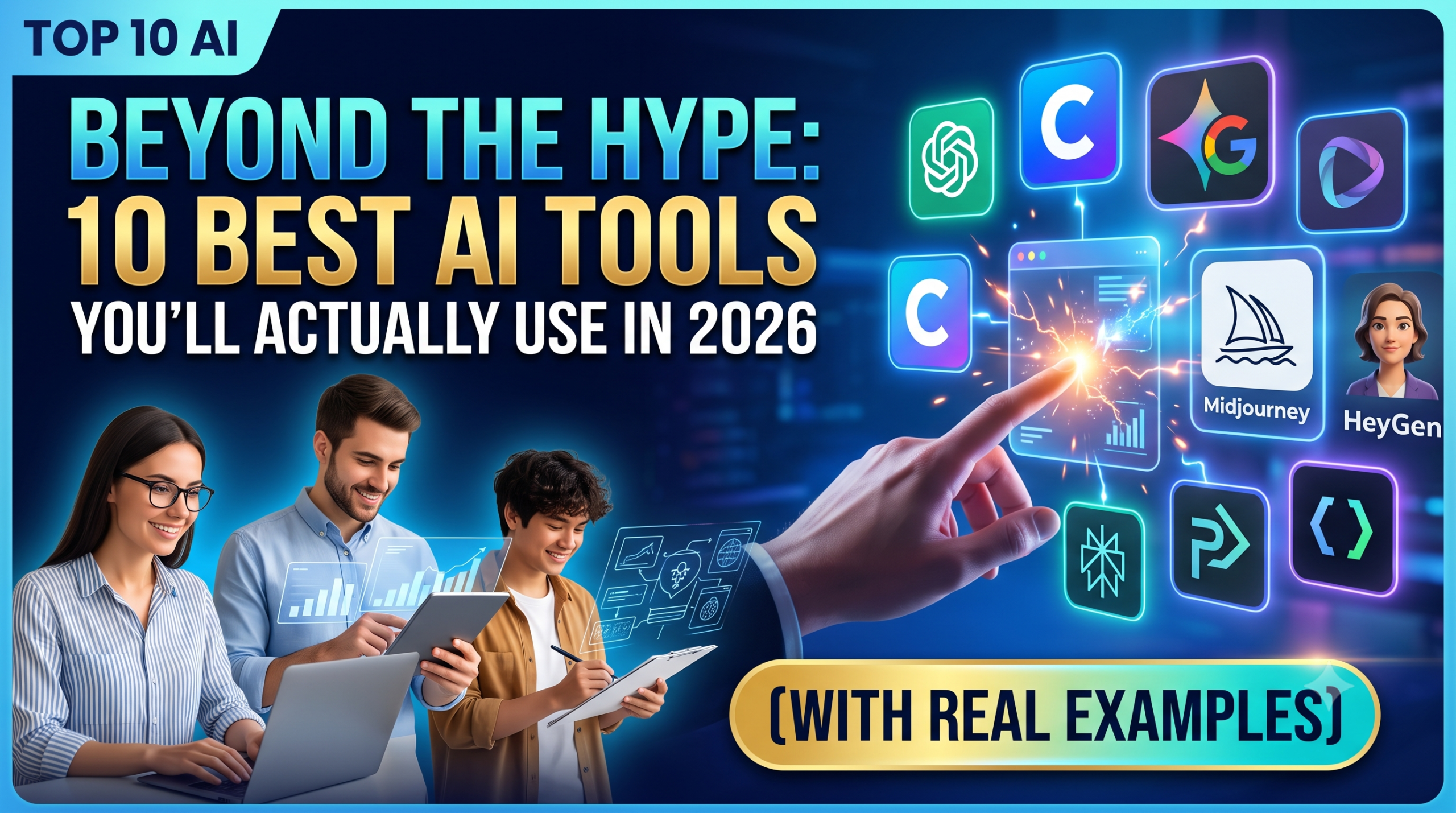
Let’s be completely honest for a second. If you’ve spent any time reading about artificial intelligence lately, you’ve probably noticed that a lot of online content sounds exactly the same. It’s almost always some variation of: “In the rapidly evolving landscape of digital transformation, leverage this paradigm-shifting technology to optimize your workflows.”
Yikes. It makes you want to close the tab instantly.
Let’s skip the robotic corporate speak and talk like real people. The AI landscape isn’t just one giant chatbot anymore; it has fractured into highly specialized, incredibly powerful software. Some are built for deep analytical thinking, some for pure background automation, and others for jaw-dropping design.
If you want to know which top AI tools are actually worth your time right now—and more importantly, exactly how to use them without getting lost in the tech hype—here is the ultimate breakdown of the best productivity AI platforms making a massive difference in day-to-day work.
1. ChatGPT by OpenAI
The All-Purpose Digital Swiss Army Knife
Focus Keywords: ChatGPT features, OpenAI advanced reasoning, multi-purpose AI chatbot
We all know ChatGPT, but the way we use it has completely shifted. It’s no longer just a simple text generator or a tool for writing lazy high school essays. With its advanced reasoning engines, it acts like a tireless assistant that can pause, “think” through a highly complex problem step-by-step, and troubleshoot its own errors before giving you an answer.
- Best Used For: Complex problem-solving, structural brainstorming, and writing heavy lifting.
- Real-World Example: Imagine you are drowning in data. You have a massive, ugly CSV spreadsheet containing customer feedback from the last six months. Instead of spending days sorting it, you upload the file to ChatGPT and say: “Analyze this feedback. Group the complaints into five main buckets, tell me which one is hurting our business the most, and draft a polite email response template for that specific issue.” It handles the analysis and copywriting in seconds.
2. Claude by Anthropic
The Nuanced Writer and Master Coder
Focus Keywords: Claude AI for writing, Anthropic Claude vs ChatGPT, coding with AI
If ChatGPT is the brilliant, analytical mathematician of the AI world, Claude is the brilliant literature and computer science double-major. It has an incredible knack for grasping tone, writing copy that genuinely sounds human, and handling massive blocks of text (like an entire novel or a massive codebase) without forgetting the details.
- Best Used For: Long-form content writing, highly technical coding, and analyzing dense documents.
- Real-World Example: Say you have a 150-page legal contract or a dense technical manual. You can drop the entire PDF into Claude and type: “Find any hidden liabilities or weird clauses in this text that don’t favor me, explain them like I’m five, and rewrite them to be fairer.” It acts like a second pair of highly analytical eyes.
3. Google Gemini
The Ecosystem Researcher
Focus Keywords: Google Gemini deep research, Workspace AI tools, Gemini video analysis
Gemini’s superpower is its deep integration into the Google ecosystem (Gmail, Docs, Sheets, YouTube) combined with its massive “context window”—meaning it can process hours of video or audio files in one go. Its autonomous research features can browse the web, verify facts, and build interactive reports without you having to click through dozens of tabs.
- Best Used For: Deep web research, handling video/audio files, and seamless Workspace productivity.
- Real-World Example: You missed a two-hour company town hall meeting, but you have the video recording. You upload the video to Gemini and ask: “Give me a bulleted breakdown of what the CEO said about the budget cuts, find the exact moment they mentioned the marketing team, and draft a summary note I can Slack to my team.”
4. Perplexity AI
Google Search on Steroids
Focus Keywords: Perplexity AI search, conversational search engine, real-time AI research
Traditional search engines are broken. They give you ten blue links and force you to dig through spammy, ad-filled websites to find a simple answer. Perplexity doesn’t do that. It reads the internet for you in real-time, synthesizes the information into a clean paragraph, and explicitly links its sources so you can instantly verify them.
- Best Used For: Fast, accurate, real-time factual research.
- Real-World Example: You are planning a business trip to Tokyo and want to find niche, non-touristy coffee shops that roast their own beans in a specific neighborhood. You ask Perplexity. Instead of a list of Yelp ads, it gives you a curated list of four specific shops, explains why they fit your criteria, and links the local travel blogs it pulled the information from.
5. Cursor
The Developer’s Secret Weapon
Focus Keywords: Cursor AI code editor, AI software development, text to code tools
Cursor took the programming world by storm by taking Microsoft’s VS Code and rebuilding it from scratch with native AI roots. It doesn’t just autocomplete lines of code; its conversational agents can look at your entire software project folder and write whole features across multiple files simultaneously.
- Best Used For: Software development and “vibe coding” (building apps purely via text instructions).
- Real-World Example: You want to add a dark-mode toggle and a new user profile dashboard to your web application. Instead of writing the code manually, you open Cursor and say: “Look at my current app architecture. Create a new dashboard component that matches our current design style, wire it up to the database, and make sure it looks great on mobile.” It executes the changes across your backend and frontend.
6. Midjourney
The Undisputed King of Visual Design
Focus Keywords: Midjourney image generation, commercial AI art, creative AI tools
While almost every chatbot can throw a basic image together now, Midjourney is where creative professionals go for hyper-realistic photos, stylistic concepts, and stunning branding visuals. Its ability to maintain style and character consistency across multiple images makes it incredibly powerful for marketing teams.
- Best Used For: Mood boarding, marketing visuals, and concept art.
- Real-World Example: You are launching an eco-friendly skincare line and need mockups for your website before the product is physically manufactured. You type a prompt into Midjourney: “An amber glass dropper bottle sitting on a wet, mossy stone in a misty forest, soft cinematic lighting, high-end commercial product photography.” You get a flawless, professional-grade visual asset.
7. Zapier Agents / Make
The “Set It and Forget It” Automation Engine
Focus Keywords: Zapier workflow automation, autonomous AI agents, business automation tools
It’s one thing to chat with an AI; it’s another to let it run your business background workflows. Platforms like Zapier and Make allow you to build autonomous “agents” that connect thousands of everyday apps together, executing complex tasks based on real-world triggers without you ever opening your laptop.
- Best Used For: Saving hundreds of hours on repetitive administrative workflows.
- Real-World Example: You can set up an agent that watches your business inbox. When a high-value sales lead emails you, the AI automatically reads the email, extracts the client’s budget, inputs them into your CRM (like Salesforce), drafts a personalized follow-up email based on their request, and pings your phone on Slack to say: “Hey, I set up a draft response for a new $10k client. Take a look.”
8. HeyGen
Scalable Video Production Without a Camera
Focus Keywords: HeyGen video generator, AI avatars for business, voice cloning software
Video production used to require expensive cameras, lights, microphones, and hours of tedious editing. HeyGen lets you create stunningly realistic AI avatars that speak whatever text you type. You can even clone your own voice and face with a short video clip, allowing you to create personalized videos in dozens of languages instantly.
- Best Used For: Scalable sales outreach, training modules, and localized content creation.
- Real-World Example: You need to send a personalized video greeting to 100 different international clients. You record a single template of yourself. You then use HeyGen to automatically swap out the client names and translate the script into perfect Spanish or Japanese, complete with flawless lip-syncing that matches your original voice.
9. DeepSeek
The Affordable Open-Source Powerhouse
Focus Keywords: DeepSeek open source AI, cost-effective AI models, data crunching tools
DeepSeek completely disrupted the AI industry by proving you don’t need a trillion-dollar budget to build a world-class AI model. It is an open-source model that handles deep reasoning, advanced mathematics, and complex coding at a absolute fraction of the cost of its mainstream competitors.
- Best Used For: Heavy data crunching, complex math, and cost-effective AI operations.
- Real-World Example: A small software startup wants to build a custom customer-service bot but doesn’t have the budget to pay heavy API fees to tech giants. They deploy DeepSeek to handle massive volumes of technical troubleshooting queries locally, getting top-tier reasoning without the crippling invoice at the end of the month.
10. Slack and Teams AI Companions
The Proactive Coworker in Your Chat Room
Focus Keywords: Slack AI tools, workplace AI assistant, project management AI
Most AI tools wait for you to go to them, log in, and type a prompt. A new breed of workplace AI tools—like native Slack AI or Microsoft Teams assistants—live directly inside your company’s communication channels. They lurk in the background, read the ongoing conversations, and proactively volunteer to help.
- Best Used For: Team coordination, project management, and cross-referencing company internal knowledge.
- Real-World Example: Your engineering team is discussing a bug in a Slack thread, trying to figure out why the website crashed last night. The AI assistant jumps into the thread on its own and says: “Hey guys, I noticed you’re looking at the server logs. I cross-referenced this error with the code update pushed yesterday at 4 PM, and it looks like a missing database index is causing the crash. Would you like me to write the fix and create a Jira ticket?”